


How Pilates Supports Your Mental Health

There are moments when it’s not your body that’s tired.
It’s your mind.
Thoughts that won’t stop.
Tension that stays even when you lie down.
That feeling of always being “on alert,” even when you don’t quite know why.
And many times, without realizing it, the body starts carrying all of that.
That’s where Pilates comes in.
Not as a magic solution.
But as a space where, finally, you’re allowed to slow down.
It’s not about doing more, it’s about being more present
Movement is always helpful.
But not all movement brings calm.
Pilates doesn’t ask for speed or excessive effort.
It asks for presence.
To be where you are.
To feel your breath.
To notice what activates—and what can soften.
And when your attention returns to your body, something shifts:
your mind stops racing so fast.
Not because problems disappear,
but because they no longer pass through you with the same intensity.

Coming back to your body is also coming back to yourself
Joseph Pilates spoke of Contrology:
the ability to coordinate mind, body, and breath.
And today, that feels more necessary than ever.
We live fast.
We think constantly.
We barely breathe.
Pilates proposes the opposite:
doing less, but doing it with awareness.
Breathing becomes deeper.
Movement becomes clearer.
The body starts to feel like a place you can live in again.
And from there, the mind can finally rest.
When practice also supports you emotionally
Many people come to Pilates looking to move…and stay because they find something more.
A space without comparison.
Where you don’t have to prove anything.
Where every body is welcome exactly as it is.
Well-guided classes create something simple, yet powerful:
a sense of belonging.
Moving alongside others, in a cared-for environment,
also helps ease anxiety, loneliness, and mental noise.
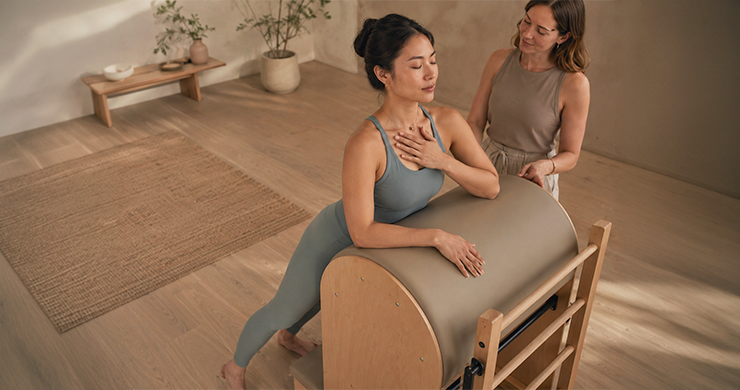
Sleeping better, thinking more clearly, feeling calmer
When the mind is unsettled, rest often suffers.
Poor sleep. Waking up tired. Living on autopilot.
Consistent Pilates practice helps the body regulate itself.
Not by exhausting it further, but by relaxing it differently.
Over time, many people notice that they:
sleep more deeply
wake up with more energy
feel less mental tension throughout the day
That’s no coincidence.
It’s the nervous system learning to lower its guard.
What happens inside (even if you can’t see it)
When you practice Pilates, your body releases substances that directly affect how you feel: calm well-being motivation reduced stress and anxiety
That’s why, after class, something settles. You may not always be able to explain it.But you can feel it.
And that, too, is mental health.
A space to care for your mental health as well
At Mindbody, we understand that movement isn’t always about pushing harder.
Sometimes, it’s about listening more deeply.
Here, Pilates is practiced with real attention, respect for your rhythm, and conscious guidance.
You don’t come to perform—you come to inhabit your body with more calm and clarity.
If you feel your mind needs a pause and your body needs a safe place to move, we’re here to support you.
📍 Roma Norte, CDMX
🕰️ In-person classes and beginner-friendly sessions
💬 Book your session via WhatsApp: 55 7321 6082
Sometimes, caring for your mental health begins with something as simple— and as profound— as coming back to your body.


Comments