


Pilates for tendinopathies: when your body asks for relief

If you’ve ever experienced a tendinopathy, you know it’s not just pain. It’s that persistent discomfort when you move. That everyday gesture that suddenly feels off. That sense that your body isn’t responding the same way.
Achilles tendon, elbow, shoulder, wrist… it doesn’t matter where it shows up. When a tendon hurts, the body starts to protect itself. It tightens, compensates, and changes the way it moves. And often, that ends up making things worse.
That’s when it’s worth pausing and asking: what does my body really need to recover?

Understanding tendinopathy without fear
Tendinopathies affect the tendons, the structures that connect muscle to bone and make movement possible.
They can develop from overuse, impact, or poor movement patterns.They don’t appear overnight.They are usually the result of repeating the same pattern without enough support.
That’s why recovery isn’t just about removing pain. It’s about learning to move better.
It works through control, precision, and body awareness.This allows you to build strength without overload and move without unnecessary impact.
In the case of the Achilles tendon, for example, Pilates helps organize the entire leg: feet, ankles, calves, and hips.When the body moves as a whole, the tendon no longer has to compensate on its own.
It’s not about doing more.It’s about doing it better.

When the issue is in the elbow, shoulder, or wrist
Tendinopathies in the upper body often appear when stability is lacking.
When the shoulder doesn’t support properly, the elbow compensates.When the center isn’t engaged, the wrist takes on extra load.
Pilates focuses on building a stable base so movement becomes more efficient.Exercises performed with control strengthen the muscles around the joint and gradually reduce the load on the tendon.
Nothing abrupt.Nothing aggressive.The body sets the pace.
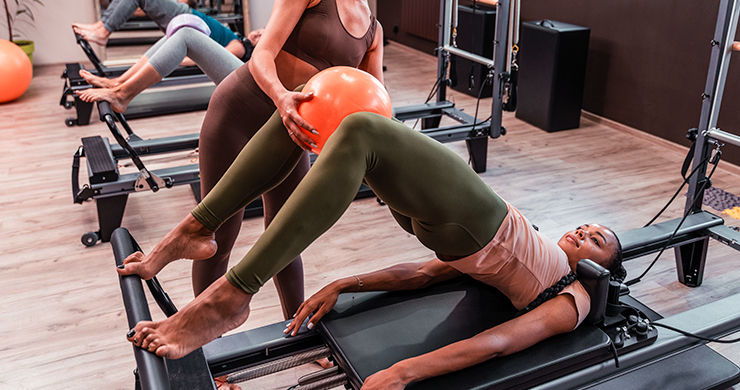
Rehabilitation is also relearning how to move
One of the most valuable aspects of Pilates is that it doesn’t just rehabilitate, it educates.
It helps you recognize:
● When you’re forcing
● When you’re compensating
● When movement can be clearer and safer
This not only supports recovery, but also helps prevent recurrence.
The importance of proper guidance
With a tendinopathy, not every exercise works for every body.
Adaptation, progression, and professional guidance make the difference.A trained approach ensures the process is safe, respectful, and effective.
The goal is not to rush recovery.It’s to make it sustainable.

Rebuilding trust in movement
A tendinopathy can make you lose trust in your body. It can make you move with fear. Or avoid movement altogether.
Pilates offers a different path: to move again with support, control, and confidence.
Because healing is not always about pushing harder. Sometimes, it’s about moving with more awareness.
And when that happens, movement stops hurting… and starts to feel possible again.


Comments